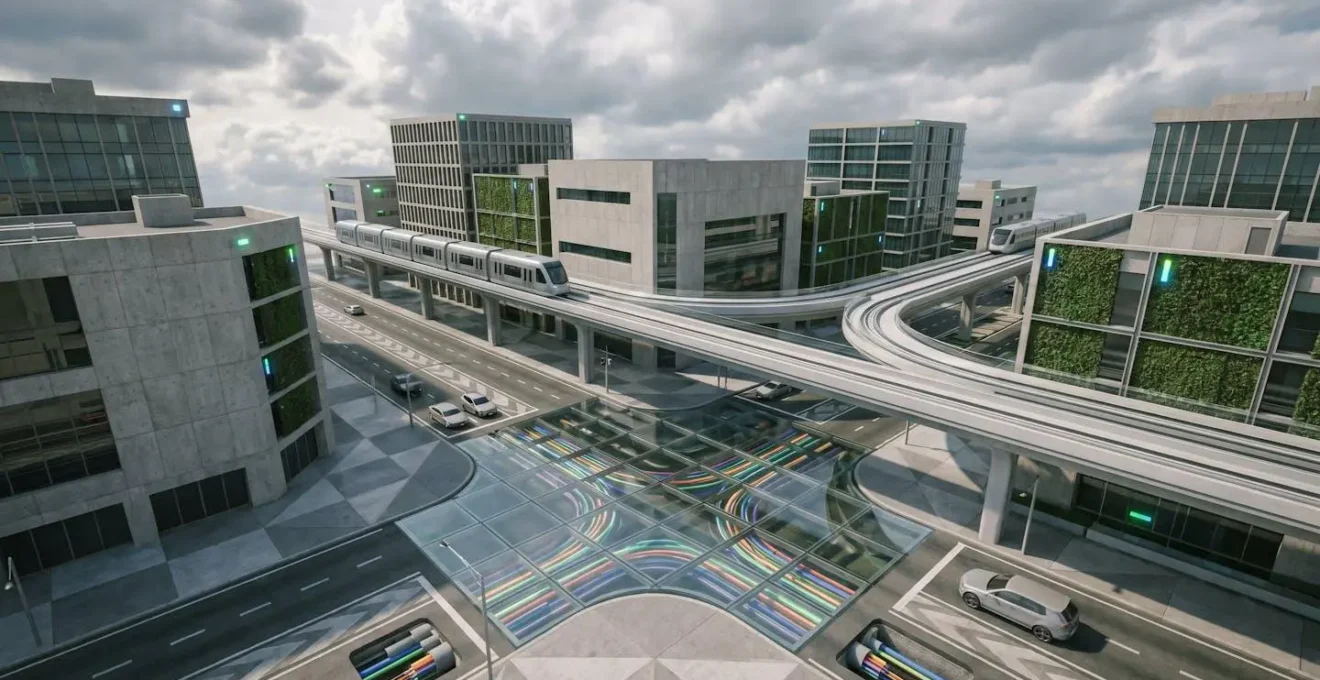
The true value of infrastructure for PropTech isn’t its existence, but how its data is weighted for second-order effects and time-decay.
- Valuation models must move beyond simple proximity to differentiate the nuanced value between upgrades like EV charging points and cycle lanes.
- Algorithms that don’t account for project cancellations or delays—”zombie projects”—are systematically overvaluing assets.
Recommendation: Integrate predictive analytics by scraping council planning portals and applying time-decay models to all announced public works to build a more accurate, forward-looking valuation engine.
For PropTech startups and investors, the axiom that “good infrastructure increases property value” is table stakes. Automated Valuation Models (AVMs) have long factored in proximity to train stations and the quality of local schools. However, this simplistic view is becoming a liability. In an era of smart cities, the data landscape is exploding in complexity and richness. Relying on outdated, binary metrics—does a property have fibre, yes or no?—is like navigating a metropolis with a pirate’s map. The real value is no longer in the announcement of an infrastructure project, but in the granular data that surrounds its lifecycle, adoption, and knock-on effects.
The challenge is that most AVMs are not equipped to handle this nuance. They see a new tram line on a planning document and assign a value uplift, ignoring the potential for cancellation, delays, or the fact that the resulting gentrification may be driven more by zoning changes than the transport itself. This leads to significant model errors and mispriced risk. The fundamental flaw is treating infrastructure as a static feature rather than a dynamic data stream. But what if the true competitive edge wasn’t just knowing *that* an upgrade is happening, but precisely modelling *how* it will unfold and impact the surrounding ecosystem over time?
This article moves beyond the blueprint to the data layer. We will deconstruct how to build more resilient and accurate PropTech valuation models by treating municipal upgrades as a complex dataset. We will explore how to quantify the value of next-generation infrastructure, predict hotspots before they appear on any real estate portal, and, most critically, how to avoid the algorithmic traps created by the hype cycle of urban development.
This analysis will equip you with a forward-thinking framework to navigate the intricate relationship between public works and private asset valuation. The following sections break down the key data challenges and opportunities, providing a roadmap for turning municipal data into a powerful predictive asset.
Summary: How Municipal Data Shapes PropTech Valuation Models
- Why Does Fibre-Optic Rollout Correlate with a 5% Uplift in Commercial Rents?
- How to Scrape Council Planning Portals to Predict Infrastructure Hotspots?
- EV Charging Points or Cycle Lanes: Which Infrastructure Adds More Value to Residential Data?
- The Algorithm Error That Overvalues Properties Based on Cancelled Infrastructure Projects
- How to Weight Municipal Upgrades in AVMs for More Accurate Pricing?
- New Tram Line or Train Station: Which Driver Accelerates Gentrification Faster?
- The Interoperability Mistake That Leaves Your Digital Twin Incomplete
- Using Digital Twins to Optimise Commercial Building Performance?
Why Does Fibre-Optic Rollout Correlate with a 5% Uplift in Commercial Rents?
The correlation between fibre-optic connectivity and increased commercial rent is often attributed simply to “better internet.” However, the 5% uplift is not just about faster download speeds for tenants; it’s a proxy for a much larger economic shift. The real driver is the area’s capacity to support next-generation, data-intensive industries. High-speed connectivity is the foundational layer for everything from AI development and cloud computing to the remote-first work culture that demands robust digital infrastructure at home and in satellite offices. For a commercial tenant, a building with fibre isn’t just a convenience; it’s a future-proofed asset that signals the landlord’s investment in high-value business operations.
From a data analyst’s perspective, the rollout of fibre is a leading indicator of an area’s transformation into a high-value economic node. This is particularly evident in the context of large-scale data centres. A recent analysis reveals that when utilities upgrade the local electrical grid and fiber-optic networks to support AI training hubs, they create powerful “Infrastructure Equity” ripple effects. This public-private investment creates a halo of development potential and value appreciation in a 5 to 10-mile radius, impacting not just commercial but also residential properties.
Therefore, when modelling this in an AVM, the variable shouldn’t be a binary `has_fibre`. A more sophisticated model would weight the presence of fibre based on the capacity of the local grid and the proximity to other data-intensive businesses. The 5% uplift is the result of a symbiotic relationship between infrastructure and the high-value economic activity it enables, a classic second-order effect that simplistic models often miss.
How to Scrape Council Planning Portals to Predict Infrastructure Hotspots?
While real estate portals show you what’s happening now, municipal planning portals show you what’s going to happen in two to five years. For PropTech investors, this is the closest thing to a crystal ball. These portals are treasure troves of raw, unstructured data on proposed developments, zoning changes, and public works projects. The ability to systematically scrape, parse, and analyse this data provides a significant competitive advantage, allowing investors to identify and acquire assets in future infrastructure hotspots before the market prices in the growth.
The process, however, is not a simple keyword search. It requires a robust data pipeline. This typically involves using web scraping tools (like Scrapy or BeautifulSoup in Python) to regularly pull new planning applications. The real challenge lies in parsing the unstructured text and PDF documents. This is where Natural Language Processing (NLP) becomes critical. NLP models can be trained to identify key entities within these documents, such as project type (e.g., “new metro station,” “fibre optic network expansion”), budget allocations, key dates, and project status (e.g., “proposed,” “approved,” “funded”).
By structuring this data, an analyst can create a time-series database of all planned infrastructure in a given region. This allows for the creation of predictive heatmaps showing areas with the highest concentration of future investment. More advanced models can even calculate a “confidence score” for each project based on its progression through bureaucratic stages, helping to differentiate a speculative proposal from a fully-funded public work. This is the engine of a truly predictive AVM.
Your Action Plan: Predicting Infrastructure Hotspots
- Points of Contact: Identify and list all relevant municipal, regional, and transport authority planning portals for your target locations.
- Data Collection: Set up automated scrapers to inventory all new project documents, paying close attention to master plans, budget announcements, and public-private partnership agreements.
- Attribute Coherence: Parse and tag each project with key attributes: type, budget, timeline, and current status (e.g., proposal, funded, approved). Cross-reference with nearby amenities like schools and parks.
- Predictive Weighting: Analyse historical data on similar local projects to create a “completion probability” score for each new announcement, flagging high-risk versus high-certainty developments.
- Integration Plan: Feed this structured, time-sensitive data into your AVM to create a forward-looking layer that anticipates value shifts, rather than just reacting to them.
EV Charging Points or Cycle Lanes: Which Infrastructure Adds More Value to Residential Data?
As cities invest in green transport, PropTech models must learn to differentiate the value of various “micro-infrastructures.” It’s no longer enough to measure distance to a bus stop. The question for residential AVMs is becoming more granular: does a nearby EV charging station add more value than a protected cycle lane? The answer lies in the data, and it reveals distinct patterns of value creation that reflect different buyer priorities and lifestyles.
On one hand, the impact of Electric Vehicle (EV) infrastructure is direct and financially significant. A comprehensive California study analysing 14 million housing transactions revealed a 3.3% average price increase for homes near EV charging stations, a premium equivalent to around $17,212. This effect is hyperlocal, with the highest premium (5.8%) seen for homes within 400 to 500 metres of a charger. This data suggests that for a growing segment of the market, the convenience and “range confidence” provided by nearby charging infrastructure is a tangible asset they are willing to pay for, directly impacting the capital value of the property.
On the other hand, the value of cycle lanes is more nuanced. It’s less about a single utility and more about an entire lifestyle and urban environment. A 2026 University of Waterloo study analysing thousands of transactions found that cycling infrastructure was not associated with reduced property values, contrary to some fears. In fact, it revealed that condos near on-road bike lanes and multi-use trails showed higher sale prices. This suggests that while the premium may not be as universally sharp as for EV chargers, it strongly correlates with dense, urban property types where residents value walkability, recreation, and alternative transport options.
For an AVM, this means a one-size-fits-all approach is flawed. The weight given to EV chargers should be a function of distance, peaking at around 0.5km. The weight for cycle lanes should be co-dependent on the property type (higher for condos) and the neighbourhood’s overall “walk score” or density. The former is a utility-driven value, while the latter is an amenity-driven value.
The Algorithm Error That Overvalues Properties Based on Cancelled Infrastructure Projects
One of the most significant and costly errors in infrastructure-based valuation is the failure to account for project lifecycle and political reality. An AVM that scrapes a planning portal and immediately assigns a value uplift to a property near a “proposed new subway line” is ingesting a massive amount of risk. These large-scale projects are subject to budget cuts, political shifts, and years-long delays. When a project is inevitably cancelled or altered, properties that were algorithmically overvalued can see their paper gains evaporate, leaving investors exposed. These are “zombie projects”—dead in reality but still alive in unsophisticated datasets, poisoning valuations.
This is where the concept of a time-decay model becomes essential for any serious PropTech platform. Instead of a binary “project announced” flag, the model must treat the potential value uplift as a probability that decays over time. Upon announcement, a project might be assigned a 10% probability of adding its full potential value. As it secures funding, passes regulatory hurdles, and begins construction, that probability increases. Conversely, if a project stagnates with no updates for 12-18 months, its value contribution to the AVM should automatically decay towards zero.
This approach requires more than just scraping data; it requires monitoring the *velocity* of a project’s progress. As experts from Ratnaakar Property Advisory note, this is a fundamental part of due diligence:
Delays in project implementation, shifts in policy, and inadequate planning can hinder the expected benefits of infrastructure development. Investors should conduct thorough due diligence, assess the reliability of timelines, and factor in possible delays before making financial commitments.
– Ratnaakar Property Advisory, The Impact of Infrastructure Growth on Property Value
Failing to model this decay is a rookie mistake. A robust AVM doesn’t just see the blueprint; it sees the political and financial headwinds that can turn a multi-billion dollar project into a forgotten press release.
How to Weight Municipal Upgrades in AVMs for More Accurate Pricing?
Once you’ve identified and risk-adjusted for infrastructure projects, the next critical step is correctly weighting their impact within an Automated Valuation Model (AVM). Assigning an arbitrary 5% uplift for a new train station is a blunt instrument. A truly accurate model weights upgrades based on their type, scale, and, most importantly, their empirically measured net benefits. The goal is to move from correlation to causation, using granular data to define how much value a specific type of project actually creates.
A prime example of this methodology comes from analysing climate adaptation infrastructure. These projects—such as sea walls, stormwater pumps, and elevated roads—are no longer just about mitigating risk; they are becoming significant drivers of property value. A groundbreaking peer-reviewed study from the University of Chicago provides a blueprint for how to weight these upgrades. The analysis of over 400,000 property transactions found that 162 adaptation infrastructure projects in Miami-Dade County generated an aggregate mean benefit of $0.68 million per project. Properties in the vicinity of these completed projects appreciated significantly, generating almost $300 million in aggregate net benefits.
This data provides a concrete weighting factor. Instead of a vague “climate resilience” score, an AVM can now assign a specific, defensible value uplift based on a property’s proximity to a completed adaptation project, with the uplift quantified by peer-reviewed economic analysis. This same principle can be applied to other infrastructure types. By analysing historical transaction data post-completion of similar projects (e.g., public parks, fibre rollouts, new schools), data scientists can build a library of weighting factors. For instance, the model could learn that a new “A-rated” high school adds an average of 7% to property values within a 1-mile radius, while a new community park adds 3%.
This evidence-based approach transforms the AVM from a simple regression model into a sophisticated economic engine. The key is to continuously back-test these weights against real-world transaction data, refining the model as new infrastructure is completed and its true impact is measured in the market.
New Tram Line or Train Station: Which Driver Accelerates Gentrification Faster?
A common assumption in real estate is that major transit infrastructure, like a new train station or tram line, is a primary driver of gentrification. While there is a strong correlation, sophisticated analysis shows that the mode of transport itself is often a secondary factor. The true accelerator of gentrification velocity—the rate at which an area’s demographics and property values change—is more often found in the second-order effects of the project, particularly the accompanying zoning policies.
This crucial distinction is a frequent source of error in valuation models that oversimplify the impact of transit. A model might assign a higher value to a regional train station than a local tram line based on passenger capacity, but this can be misleading. The key is whether the new infrastructure is coupled with policies that encourage densification and commercial redevelopment.
Case Study: The Atlanta BeltLine Project
The Atlanta BeltLine, a massive urban redevelopment project transforming a 22-mile historic railway corridor, provides a perfect example. While the project includes light rail transit, its primary impact on property values and gentrification has been driven by the creation of parks, trails, and, most importantly, Transit-Oriented Development (TOD) zoning policies. These policies incentivised the construction of high-density mixed-use developments around the BeltLine. Analysis showed that proximity to the BeltLine itself and the associated TOD zones was a far stronger predictor of property appreciation and demographic change than proximity to a specific transit stop. It wasn’t just about moving people; it was about creating destinations and fundamentally changing land use patterns.
What this means for PropTech data models is profound. Instead of simply weighting by `distance_to_transit`, a more accurate model must create a composite variable. This variable should combine `distance_to_transit` with `zoning_status`, specifically looking for TOD overlays or upzoning authorisations within the transit corridor. A new tram line with standard residential zoning will have a dramatically different—and slower—impact on gentrification than one that comes with a master plan for high-rise condos and retail space. The infrastructure is the catalyst, but the zoning policy is the accelerant.
The Interoperability Mistake That Leaves Your Digital Twin Incomplete
The ultimate goal for many smart city and PropTech applications is the creation of a “Digital Twin”—a dynamic, virtual model of a physical asset or even an entire city. For commercial buildings, a digital twin can optimise energy consumption, predict maintenance needs, and manage space utilisation. For urban planners, it can simulate traffic flow and environmental impacts. However, the value of a digital twin is directly proportional to the quality and completeness of its data feeds. The most common and critical failure point is not a lack of data, but a lack of data interoperability.
An incomplete digital twin is one that operates in a silo. It might have perfect real-time data from the building’s own HVAC and security sensors, but if it cannot ingest data from external municipal systems, it’s flying half-blind. For example, a building’s energy management system might be trying to pre-cool the building ahead of a heatwave, but without access to the local utility’s real-time grid load data, it cannot optimise its strategy to avoid peak demand charges. Similarly, a logistics hub’s digital twin can’t optimise its delivery schedules without real-time traffic data from the city’s transport authority.
This mistake stems from building systems with proprietary data formats and closed APIs. Each data source—the city’s waste management schedule, the public transit authority’s real-time bus locations, the police department’s crime statistics, the utility’s power grid status—is a vital piece of the puzzle. As advisory firm RochstJacques notes, these data-driven initiatives are central to modern urban planning.
Smart city initiatives that leverage data analytics and Internet of Things (IoT) technologies are becoming increasingly prevalent in urban planning efforts. These innovations aim to optimize resource allocation and improve service delivery while enhancing residents’ quality of life.
– RochstJacques Infrastructure Advisory, How Improved Infrastructure Impacts Property Values
When these data streams cannot “talk” to each other, the digital twin remains a fractured, incomplete model. The interoperability mistake is assuming that owning one’s own data is enough. A truly valuable digital twin is an integration platform, a system that can synthesise dozens of disparate public and private data sources into a single, coherent, and actionable view of reality.
Key Takeaways
- Model Time-Decay: Announced infrastructure is a probability, not a certainty. Your AVM must automatically degrade the value of stagnant or cancelled projects to avoid overvaluation.
- Quantify Second-Order Effects: The real value driver is often not the infrastructure itself but the policies (like TOD zoning) it enables. Model the policy layer, not just the physical asset.
- Prioritise Interoperability: A building’s performance is tied to the city’s performance. A digital twin that cannot ingest real-time municipal data (grid load, traffic, public safety) is fundamentally incomplete.
Using Digital Twins to Optimise Commercial Building Performance?
A complete, interoperable digital twin moves beyond simple monitoring to become a predictive and prescriptive tool for optimising a commercial building’s entire lifecycle performance. By integrating internal sensor data with external municipal data, the building ceases to be a passive container and becomes an active, responsive participant in the urban ecosystem. This fusion of data unlocks new dimensions of efficiency, profitability, and tenant experience that are impossible to achieve with siloed information.
Consider a commercial office tower. A basic Building Management System (BMS) adjusts lighting and HVAC based on a fixed schedule. A siloed digital twin might optimise this based on internal occupancy sensors. But an interoperable digital twin takes this to another level. It can cross-reference real-time public transit data to predict a surge of employees arriving after a train delay and pre-condition the relevant floors. It can access the utility’s dynamic pricing feed to shift heavy energy consumption to off-peak hours, dramatically reducing operational costs. It can even use city-wide air quality data to optimise its air filtration cycles, improving occupant health and productivity.
This level of integration has a direct impact on the asset’s bottom line and, therefore, its valuation. Buildings that can demonstrate lower operating costs, higher energy efficiency ratings (like LEED or BREEAM), and a superior tenant experience command higher rents and attract more stable, long-term tenants. Furthermore, the data itself becomes an asset. Analysis of long-term performance data from the digital twin can inform the design of future buildings, creating a virtuous cycle of continuous improvement.
The macro-economic impact is also significant. For example, analysis of technology infrastructure impact shows that the development of data centers in Loudoun County, Virginia, not only created immense asset value but also increased tax revenue by an estimated $890M. This demonstrates how a single building’s optimisation, when scaled across a district of data-intensive facilities, is directly tied to the broader economic health and development potential of the region.
Ultimately, the transition from legacy valuation methods to dynamic, data-driven models is not a matter of if, but when. For the PropTech startups and investors who master the art of sourcing, cleaning, and weighting this complex municipal data, the reward is a clearer, more accurate, and profoundly more profitable vision of the future urban landscape. The next logical step is to begin building the data pipelines and analytical frameworks to put these principles into practice.